
Bian Lian — 变脸

The changing face

Bian lian (变脸) means “face changing.” Associated with Sichuan opera in southwest China, it makes a character’s changing emotions visible through a succession of painted faces. A different mask can arrive while the performer is still moving, before the audience has worked out how the previous one disappeared. The Smithsonian describes masks conveying feelings including fear, tension, anger and relief.

This sits within a wider theatrical language. Chinese opera uses costume and makeup to communicate character, alongside music and movement; its regional traditions have their own musical and spoken styles. The faces shown here are an artistic interpretation, rather than a catalogue of named opera characters. Compare the painted eyes, mouth and contrasting areas of colour as each face changes.

Smithsonian: Face Changing ↗

Inside the costume

The costume belongs to the performance as much as the mask does. Its surface gives the audience something to read, while its construction can support what they cannot see. The Smithsonian describes one technique in which silk threads connect masks to different parts of the costume: one face is removed as another is drawn down into place. That is one documented method, not a complete explanation of every face-changing act.

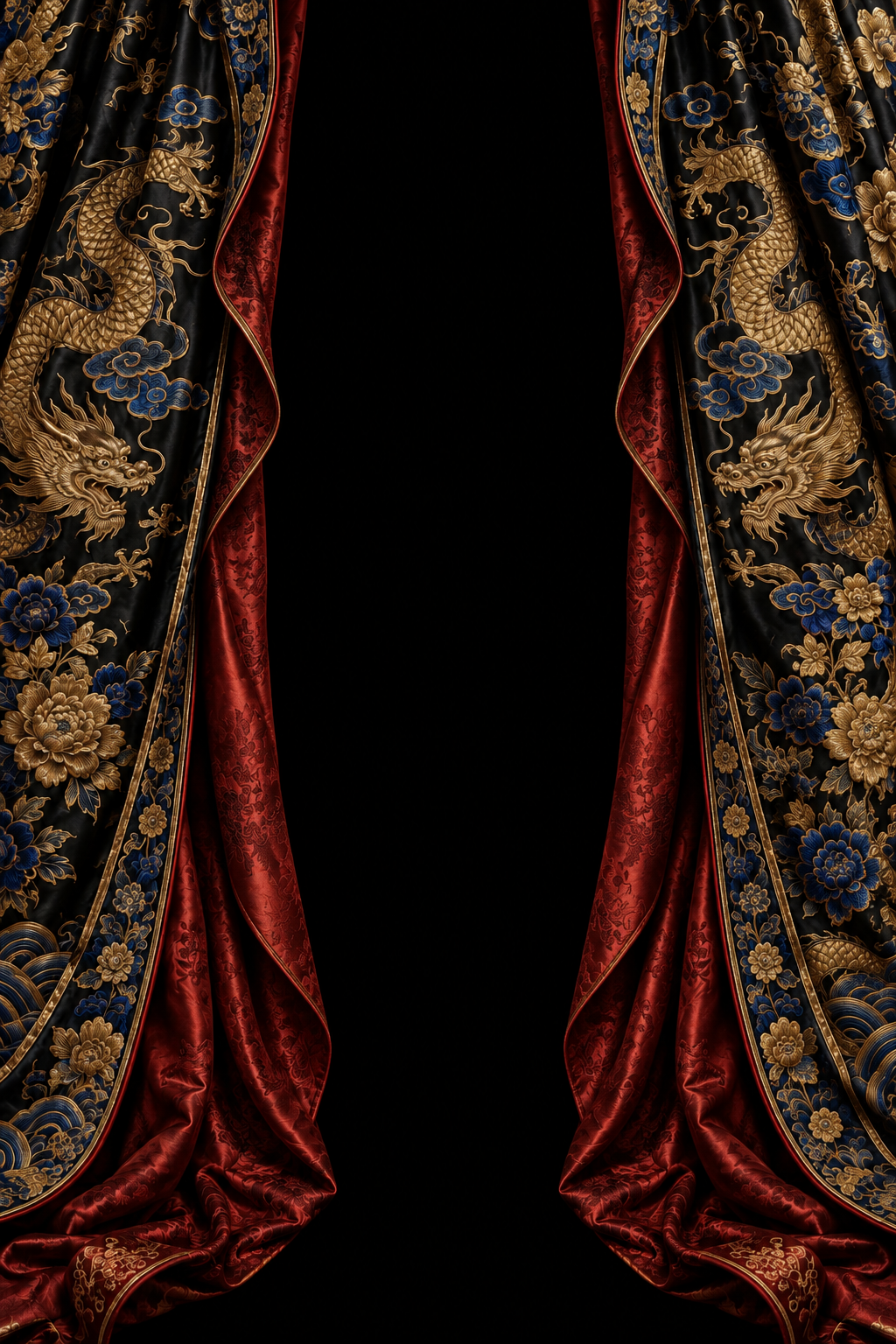
Here, the outer embroidery opens onto a separate silk lining. A gold face rises from behind the unfolding fan. Later, two painted faces separate as the fabric opens around the film. The fan and surrounding layers conceal the transitions until the opening grows wide enough to reveal them. This animation is an invented visual interpretation, not a reconstruction of a practitioner’s secret apparatus. As you scroll, the layers part in sequence, showing how something can remain out of sight until the fabric moves.

Smithsonian: Face Changing ↗

Behind the fan

The performance

The film below shows Hu Dongxiao of the Zhejiang Wu Opera Troupe at the 2014 Smithsonian Folklife Festival. In the short sequence, he presents seven faces in sixty seconds. The troupe’s adoption of face changing from Sichuan opera also shows how a technique can travel between regional performance traditions. Wu opera comes from Zhejiang in eastern China; it brings music, dance and acrobatics together.

Watch the whole figure as well as the face. Follow the head, shoulders and hands before a change, then look at how the next mask alters the expression. Viewing the same passage twice gives you a chance to follow the sequence of gestures as well as the succession of colours. The recording provides a real performance to set beside the imagined costumes and interactive masks on this page.

Smithsonian: Zhejiang Wu Opera Troupe ↗

Watch the performance

Smithsonian Folklife Festival · 1 min 34 sec

Loading the film connects to YouTube (Google), which may process device information and use storage. Data & Privacy

Hu Dongxiao · Zhejiang Wu Opera Troupe
Performance: Smithsonian Folklife Festival, 2014

Use your hand

Allow your camera, then sweep your hand across the mask to change its face.

Your video stays on your device.